

Key Takeaways
- Hands-on preschool learning uses sensory play, building activities, and art to introduce language and early numeracy through everyday experiences.
- Role-play and daily routines help children practise social skills, independence, and practical life vocabulary in real contexts.
- Teachers observe and document play-based activities to link classroom experiences with curriculum goals and share progress with families.
- Mandarin playgroups integrate bilingual language exposure into play, routines, and discovery activities rather than separate language lessons.
Introduction
Parents visiting a Mandarin playgroup in Singapore notice classrooms filled with trays, blocks, sand, and paint rather than worksheets. Hands-on preschool learning offers activities where children touch, build, pour, sort, and role-play as part of ordinary lessons. Families sometimes worry that practical tasks replace academic learning, yet teachers use these activities to introduce language, numbers, and social routines. Parents can easily compare programmes and decide whether a classroom environment matches their expectations for early childhood when they know what hands-on preschool learning looks like.
Sensory Exploration As Everyday Learning
Teachers set up sensory stations with rice, water, leaves, or foam, helping children scoop, pour, and describe textures. In a Mandarin playgroup in Singapore, teachers name colours, quantities, and actions in Mandarin and English while children experiment, supporting vocabulary and fine motor skills without formal drills. Children often work side by side, which creates natural conversations about sharing tools and taking turns. Parents see messy trays, yet teachers observe how children follow instructions and explore cause and effect.
Teachers also implement safety language, such as stop and gentle, so children learn boundaries while exploring. Cleaning routines after activities reinforce responsibility and vocabulary for tools and actions.
Art And Discovery Activities That Encourage Curiosity
Art tables and discovery corners encourage painting, mixing colours, planting seeds, or observing insects. Teachers ask questions and model new words as children describe what they see. In a Mandarin playgroup in Singapore, these conversations happen in both languages, which connects vocabulary to real objects. Hands-on preschool learning here supports curiosity and patience, as children wait for glue to dry or seeds to sprout. Displays of artwork and photos help children recall steps and talk about their process.
Children record observations with drawings or stickers, which helps them sequence events. Teachers revisit these records during circle time, prompting recall and encouraging longer descriptions.
Building And Early Maths Through Construction Play
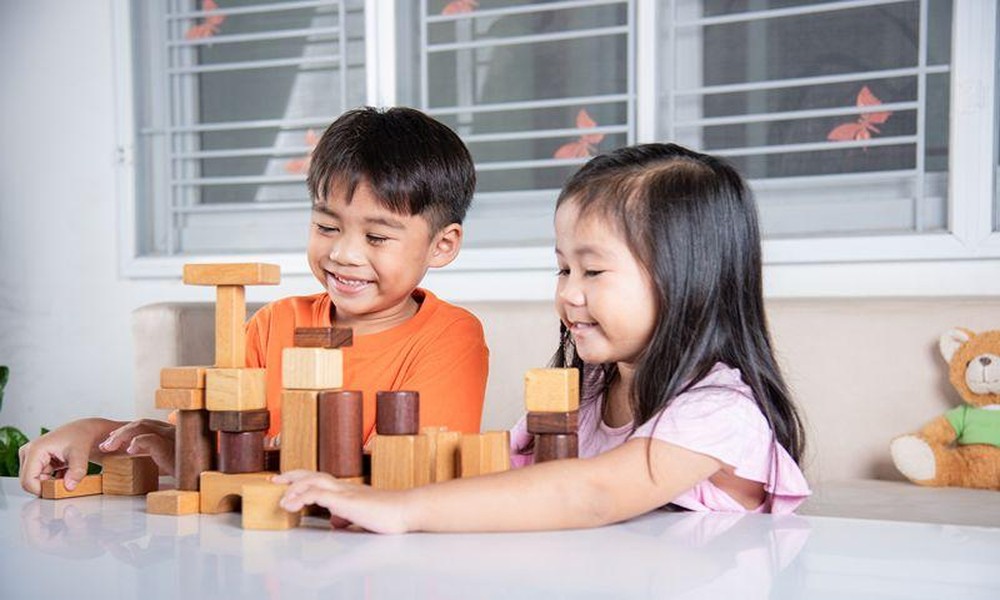
Block corners and construction tables let children stack, balance, and build. Teachers count towers, compare heights, and introduce simple shapes during play. Hands-on preschool learning in these areas links physical movement with early numeracy. Children negotiate roles when building a house or bridge, which develops language and cooperation. Teachers photograph projects and discuss them during group time, so children explain their thinking using simple sentences.
Group builds sometimes end with simple challenges, such as creating a bridge for toy cars, which introduces problem solving. Teachers prompt children to predict outcomes before testing structures.
Role-Play And Everyday Life Skills
Role-play areas simulate kitchens, shops, and clinics where children practise everyday scenarios. Teachers introduce phrases for buying, cooking, or caring for dolls, which builds social language. Hands-on preschool learning in these spaces also includes washing hands, setting tables, and tidying up materials. Children learn routines through action, which supports independence and responsibility. Parents often hear children repeating these phrases at home, which shows how classroom routines carry into family life.
Props often include labels and simple scripts, which introduce print awareness. Children switch roles during play, which exposes them to different phrases and social expectations.
Teacher Observation And Sharing With Families
Teachers document activities through notes, photos, and short videos to share progress with families. They use observations to adjust tasks, introduce new materials, or group children differently. In a Mandarin playgroup in Singapore, documentation may include bilingual captions that reinforce vocabulary. Hands-on preschool learning becomes visible through portfolios and displays, which help parents understand how play connects to language and numeracy goals. Regular updates reduce uncertainty about what children learn during apparently unstructured sessions.
Teachers invite parents to contribute materials or cultural items, which broadens classroom experiences and strengthens home-school connections.
Conclusion
Parents sometimes expect structured lessons with clear worksheets and tests, yet hands-on classrooms look busy and noisy. Practical activities still follow a plan within the curriculum, even if learning happens through play and conversation. Children may not recite lists on demand, but they demonstrate understanding through building, sorting, and storytelling. Recognising this difference between expectation and daily practice helps families interpret classroom feedback with confidence. It also clarifies how hands-on preschool learning supports language, numeracy, and social development through repeated experiences rather than formal drills, helping families feel reassured during the early years of the child’s journey.
Visit Orange Tree Preschool to learn more about hands-on learning in a Mandarin preschool.
